
How a reading works
Five minutes, start to finish — the reading points, you decide.
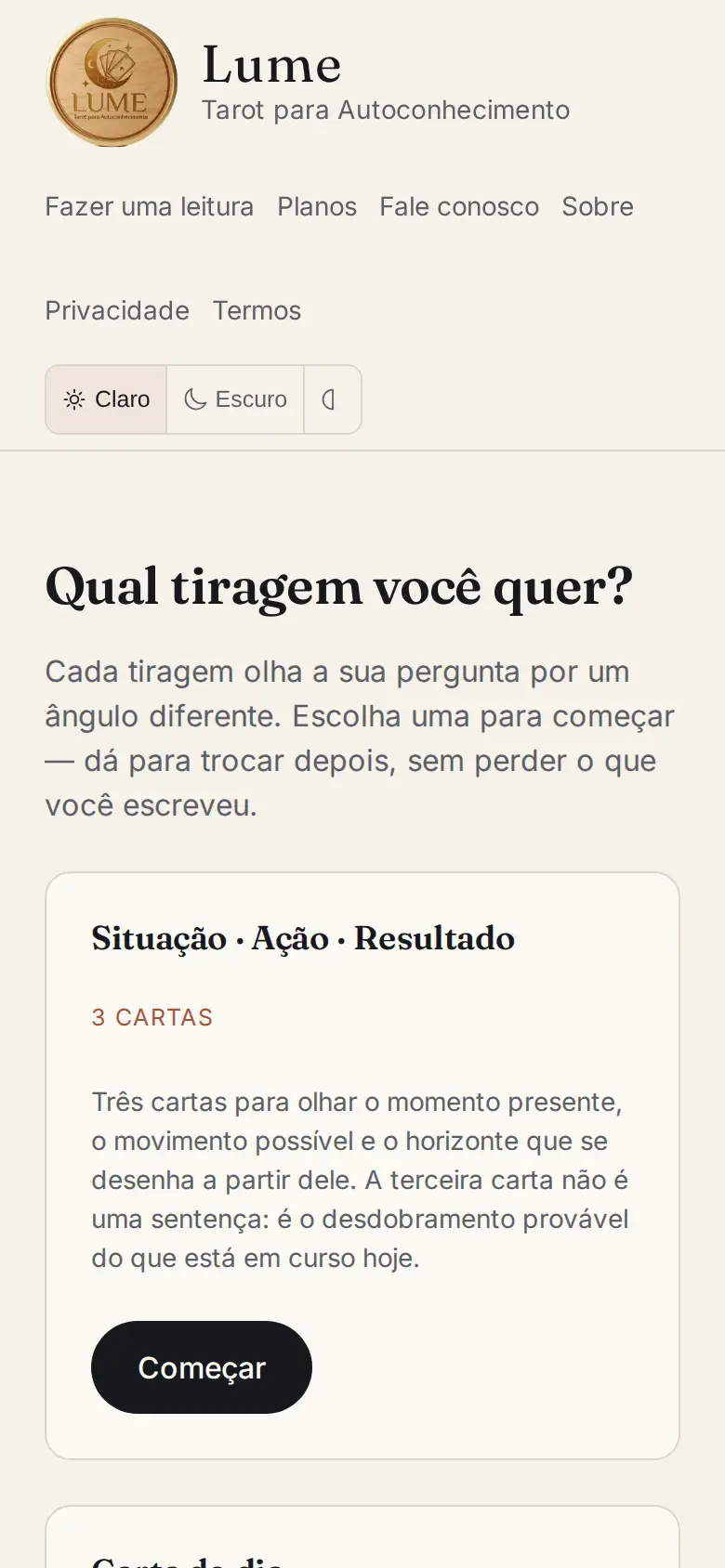
1. Choose the spread
There are five full spreads — from two to six positions — and the card of the day, a single card. Each position has a stated role (what upholds, what holds back; past, present, tendency), and it is the position that gives meaning to the card that fell in it.
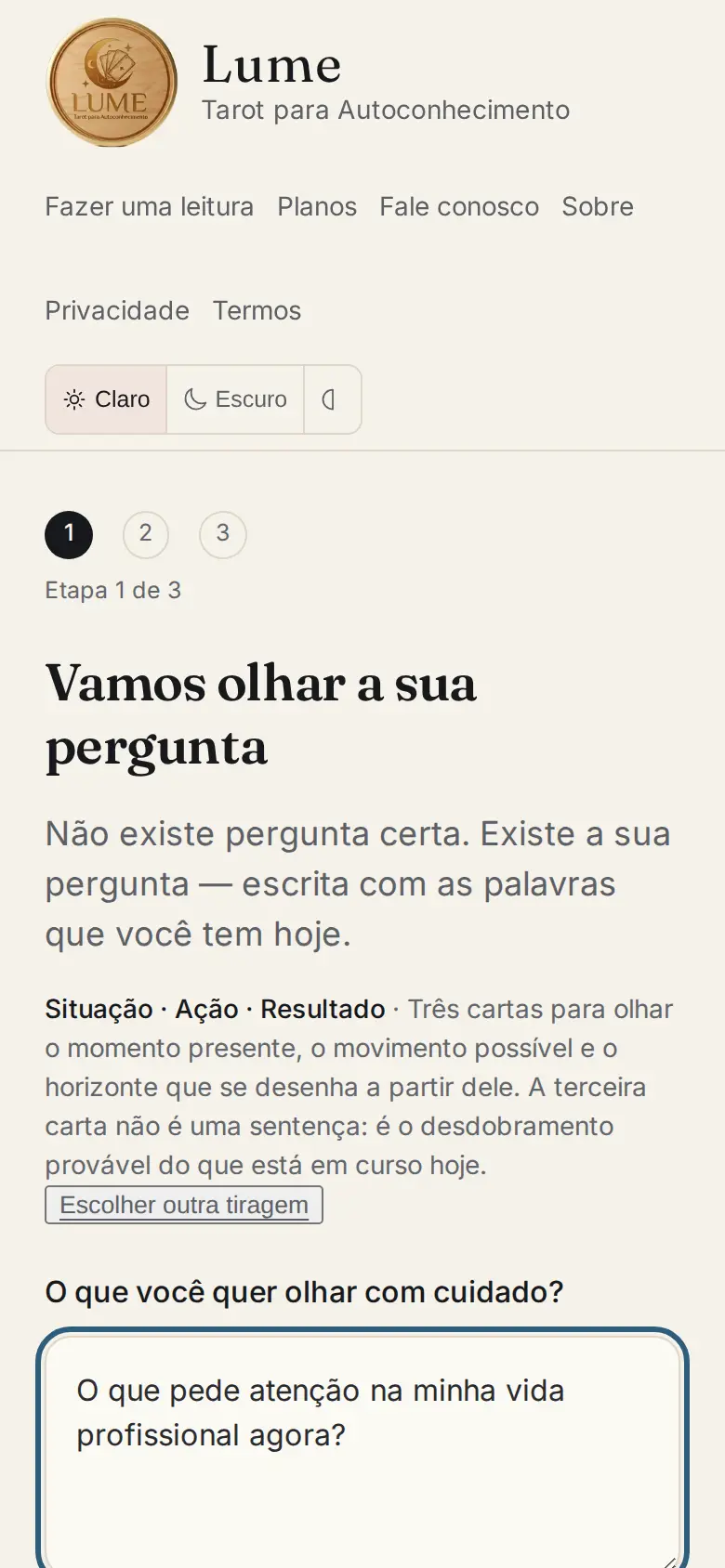
2. Write your question
The question is the centre of the reading: it is what separates a reflection from a handful of generalities. Write in your own words, your way. A direct, closed question is welcome: should I take it?, does it have a future? — what makes the reading work is the question saying what you want to understand.
Draw a spread One question, cards you pick yourself, and a reading written on the spot.
3. Sign in, if you want Helena's reading and the history
Drawing cards is open to everyone — the spread happens on its own. The account comes in for the reading written by Helena, for keeping the spread in your history and for the per-person quota. Signing in uses Google login with a verified code exchange: it is one click, one less password to keep, and Lume keeps only your e-mail and your name.
If the history matters, sign in before shuffling: the history belongs to spreads with an owner. From your question, what is recorded is only the date and the cards — its text lives in the server's memory and disappears. The full detail is in privacy.
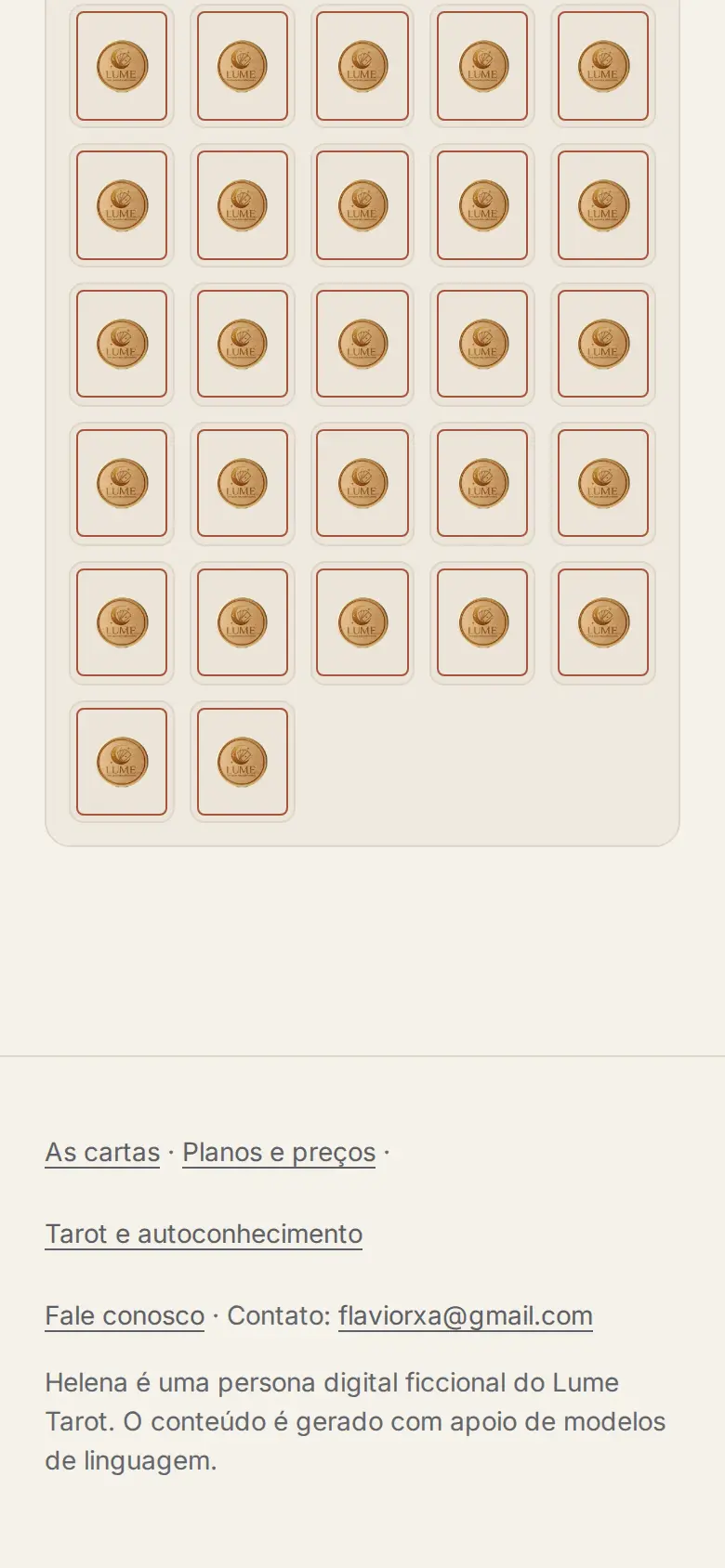
4. Draw the cards
The whole deck, 78 cards, appears face down — and you choose. The draw happens on the server, with the position and the orientation (upright or reversed) set before the card is revealed. You see the card, read its meaning and only then move on to the next position.
Draw a spread One question, cards you pick yourself, and a reading written on the spot.
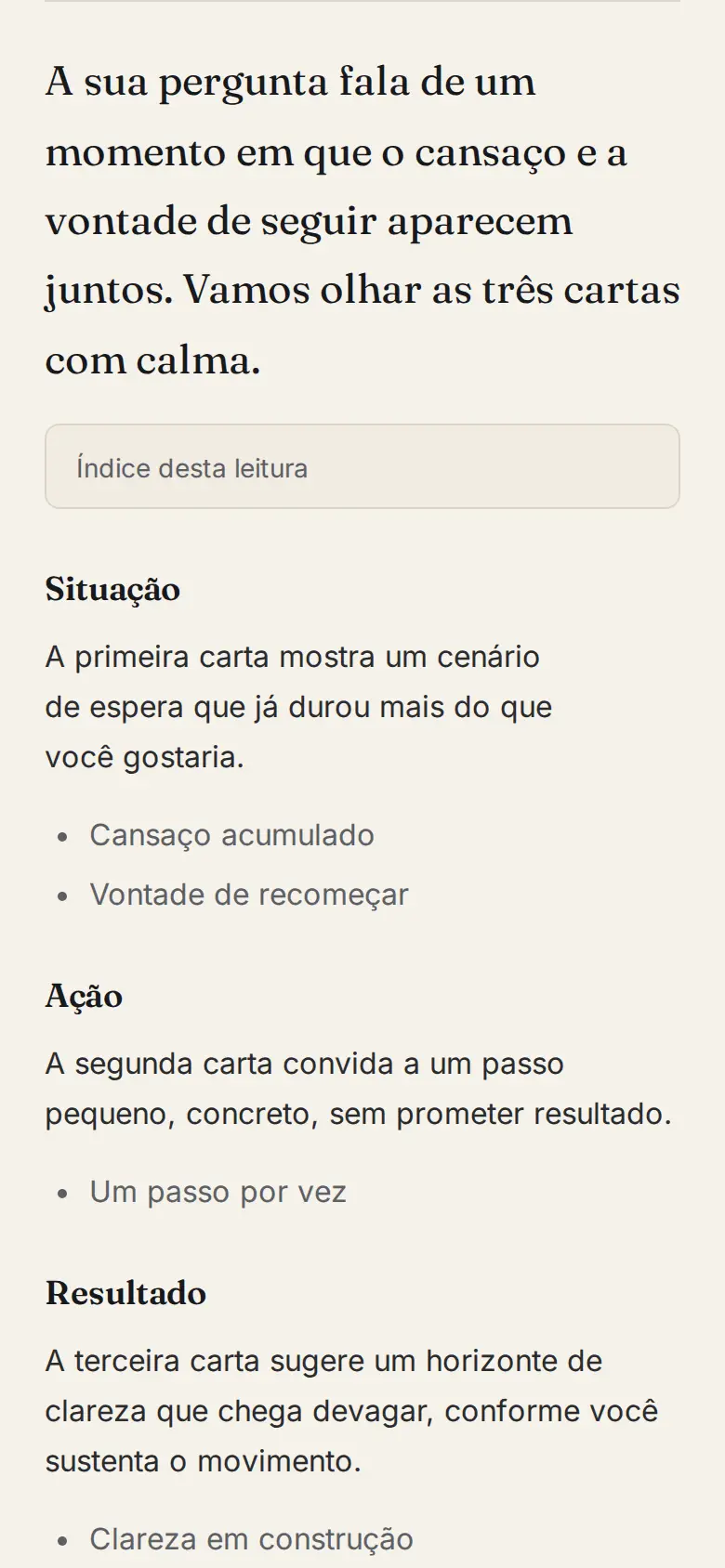
5. Read, and talk about it if you like
The reading is written on the spot: it takes a few seconds, any hour of the day or night — 3 a.m. included. The text is organised by position, and each card comes with its meaning in the orientation it came out in. At the end, you can ask follow-up questions about the same spread, to unfold what was left open.
Who writes
The readings are signed by Helena, and Helena is a fictional digital persona: an illustrated portrait and a name, created to give a face to an editorial voice. The reading is generated by language models, with the Lume method and material: the positions of the spread, the orientation of each card and its meaning. What the persona does is give unity to that voice.
And she is there any hour, on the spot: the clock is yours, and so is the reading. The reading takes a few seconds, every day, including in the small hours.
What it costs
Every day one reading comes free each day, of any spread. Want more than one in the same day? Each extra reading costs R$ 1,00, and the packs bring it down to R$ 0,50 — a one-off payment, no subscription. Beyond that, single credits are sold — each credit is one full spread, and credit lasts forever. The prices and what they include are in plans, everything in plain sight.
What is kept
Drawing cards does not require an account: someone who has not signed in can choose the spread, write the question and see the meaning of each card. What does require an account is the reading written by Helena and the history — that is why the spread needs an owner, and the per-person limit only exists with identification. The account keeps the essentials — e-mail, and the list of what you drew (the spread, the cards, the time).
For anonymous visitors, the spread lives only in the server's memory and disappears within 30 minutes; the database stays out of it. Your question and the text of the reading stay only in the server's memory, in either case: while the reading is open, and leave it within 30 minutes. If you open the history later, you find the complete spread — cards, game and reading text, to reread whenever you want. The full detail is on the privacy page.
The commitment of this experience
- Symbolic reading, with direction: the spread points to tendencies and unfoldings; dates and names belong to real life.
- Service on the spot, 24 hours a day, with Helena — a digital persona who gives voice to the reading (see above).
- Health, law and finances call for qualified professionals: the reading lights up the context and stands by the decision.
- The decision is yours: the reading interprets, points to directions and tendencies, and the choice stays with you.
For why tarot works this way, see tarot as a tool for clarity and the page about the method.
Draw a spread One question, cards you pick yourself, and a reading written on the spot.
The screens on this page are captures of the site itself, made with a test provider — what changes in your reading is the text, written from your cards. See also the terms of use.